On-Site Balancing
Balance the rotor in its own bearings, without removal
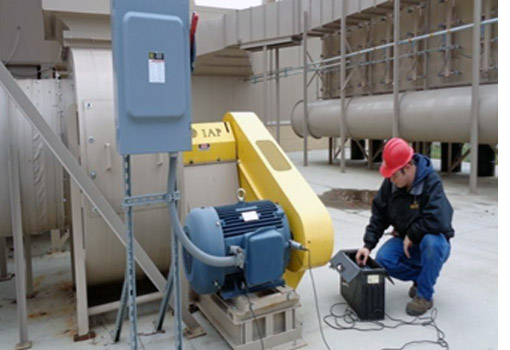
We balance fans, impellers, rotors, crusher rotors and similar rotating parts in place, at operating speed and in their own bearings. Single and dual plane balancing is performed to ISO 21940 (formerly ISO 1940) tolerance grades.
- Single and dual plane on-site balancing
- Tolerance to ISO 21940-11 (formerly ISO 1940) quality grades
- Fault discrimination before balancing (ruling out misalignment, looseness, resonance)
- Reporting with before/after vibration values
- Permanent balance weight fitting and welding
Why on-site balancing differs from workshop balancing
A workshop balancing machine removes the rotor from its own bearings and balances it at low speed. Real unbalance, however, appears with the rotor in its own bearings, with its coupling, belt tension and operating speed. On-site balancing balances the system with all its components, so it genuinely reduces the vibration levels you actually have.
It also removes the time needed to dismantle and transport the rotor — often the single largest saving.
Process
- Initial measurement. The 1X vibration amplitude and phase are measured before balancing. Causes other than unbalance (misalignment, looseness, resonance, bearing damage) are ruled out — balancing does not fix these.
- Trial weight. A known weight is attached at a known angle and the system response is measured.
- Calculation. The graphical balancing guide in Leonova Diamond calculates the correction weight and its angle.
- Correction and verification. The weight is applied and the measurement repeated; a fine-tuning run follows if needed.
- Reporting. Before/after vibration values, residual unbalance and the ISO 21940 quality grade achieved are reported.
Typical applications
Industrial fans and exhausters, centrifugal pump impellers, crusher and mill rotors, textile rollers, paper machine rolls, turbine and compressor rotors, ventilator propellers.
Frequently asked questions
How long does on-site balancing take and how long is the machine stopped?
A typical single plane fan balance is completed in 2–4 hours where access is straightforward. Most of that time is spent on the stop-start cycles between measurement runs; the machine is usually stopped briefly 3–5 times in total. Dual plane balancing, or rotors with difficult access, can extend the job to a full working day. Compared with removing the rotor and transporting it to a workshop, downtime is typically hours rather than days.
Does balancing solve every case of high vibration?
No. Balancing only reduces vibration caused by mass unbalance. Vibration from misalignment, mechanical looseness, resonance, bearing damage, belt problems or structural weakness will not be fixed by balancing — and a balance weight applied on a wrong diagnosis can make things worse. That is why we run a vibration analysis before every balancing job to separate unbalance from other causes. Unbalance typically shows a dominant amplitude at 1X running speed with a stable phase.